

We find ourselves at a uniquely consequential moment in human history.
According to the ITU, roughly 6 billion people are connected to the internet, compared to fewer than 400 million at the turn of the millennium. Three-quarters of humanity now participates in a shared digital environment where information can move across borders almost instantly.
However, more than 2 billion people remain offline. Only about 36% of Africa’s population is online, meaning roughly 64% is offline. This is the real crisis: Africa accounts for roughly 43–45% of all offline people on Earth.
The digital divide is what pushed me to pursue a Master of Science in Information Management Systems at the Malawi University of Science and Technology [research track], and specifically the entrepreneurial opportunities posited by Africa’s Digital Transformation.
In present day, artificial intelligence is diffusing through society at extraordinary speed. According to Microsoft, roughly one in six people worldwide now use generative AI tools, while nearly 80 percent of organizations report using AI in at least one business function. Global investment in AI has reached hundreds of billions of dollars annually. As I pursued my MBA at the Michigan State University, I got deeper into the question of what kind of tech we can build for those who are vastly marginalized.
Yet the technology itself is only part of the story.
The amount of compute used to train frontier AI systems has been growing at roughly five times per year since 2020, dramatically increasing humanity’s ability to generate, synthesize, and distribute knowledge. Questions that once required teams of researchers and years of analysis can increasingly be explored in hours, days, or minutes.
And yet, despite unprecedented access to information, the world’s defining challenges remain remarkably familiar: conflict, inequality, institutional distrust, climate change, corruption, political polarization, and uneven development.
As our tools become more powerful, a more difficult question emerges:
What happens when technological progress outpaces human progress?
What happens when societies gain access to better evidence but remain constrained by the same incentives, assumptions, identities, and systems that shaped previous generations?
That was the heart of my talk.
WORLD 2.0: Smarter Machines, Faster Evidence, Same Egos
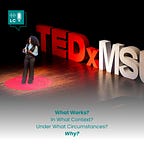
On the 22nd of March, 2026, I and 8 other leaders took to the stage with TEDxMSU, and I delivered a talk on ‘Ego’.
TEDxMSU is a non-profit initiative led by students of Michigan State University. This year’s theme was Sonder, and it celebrated the realization that every person you encounter is living a life and carries stories as vivid and complex as your own.
This being my first TEDTalk, it was ideally a very brief synthesis of a broader body of work explored throughout the both the Lessons Books [publishing on the 6th of July, 2026] - a seven-part inquiry into international development as it is lived, practiced, and inherited, particularly from the vantage point of the Global South.
That book series is my 4 year commitment, to preface this here podcast: the Lessons Conversation.
From the first industrial revolution through imperialism, neocolonialism and development to artificial intelligence and global cooperation, I in this talk examine the tension between what we now know and what we are willing to do with that knowledge.
The audio in this substack and the video on YouTube are similar, yet starkly different. I explain why and how at the beginning of the podcast.
Listen wherever you get your Podcasts [Apple Podcasts, Spotify, YouTube, etc]
If you make time to listen to both, I’d love to hear from you what were the things I may have edited out, or just forgotten to say on stage. Feel free to email me your ideas, and stand a chance to win free copies of my upcoming books [if you get some things right!]
Episode 8: Mastery [Coming Next Week]
10,000 Hours, and How Artificial Intelligence Can Get You There
In next week’s conversation, we get deeper into tech, as we explore artificial intelligence.
I am currently reading two books: Co-Intelligence by Ethan Mollick, and I Am Not a Robot by Joanna Stern. I had a sit down with the former Minister of Tourism in Malawi, Dr. Vera Kamtukule, to discuss the future of technology in Malawi, and beyond.
In that episode, we will dive deeper into how I personally use AI in my day to day life; how leaders like Ethan and Joanna use AI, and some best practices on how AI can help you advance in your personal work and explorations.
As always, keep asking:
What works?
In what context?
Under what circumstances?
and…


